
Case Study
LA County
Using AI to develop tools to improve information networks among homeless youth.
This research project addressed the dual crises of youth homelessness and high HIV risk in Los Angeles County by applying AI methods to enhance HIV prevention efforts.
With co-authors, we developed algorithms based on influence maximization (identifying the best peer leaders in a social group) and network diffusion (understanding how information spreads through a network) within the transient social networks of homeless youth.
The ultimate goal was to create pragmatic tools and insights for LA’s policymakers that guide social service communities in promoting safer behaviours.
The research was published in a peer-reviewed journal.
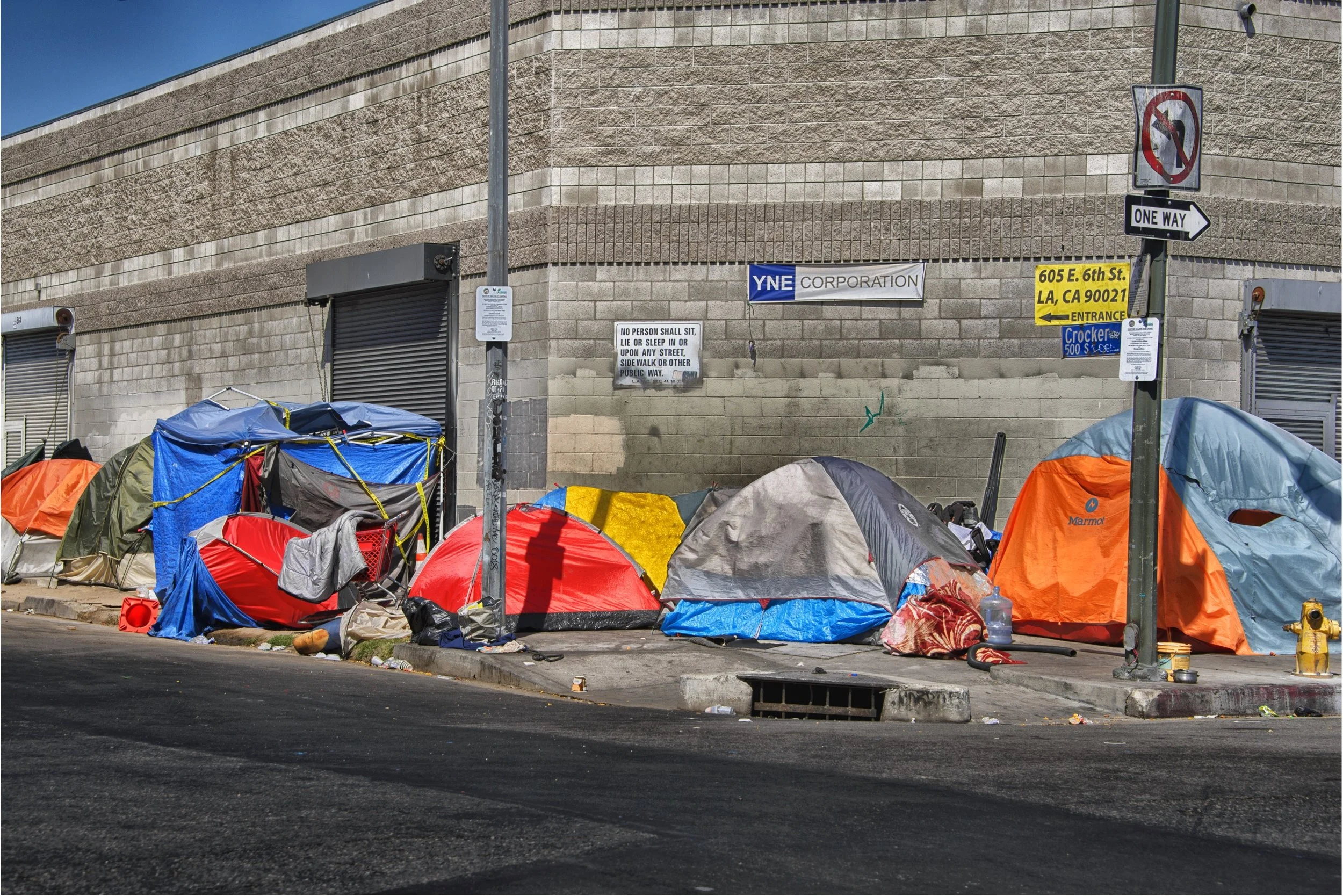
The primary goals of the project were to:
Establish model accuracy: Determine if adjusting the baseline network models – by including temporal ties and alternative relational contexts – improved the predictive accuracy of information diffusion among homeless networks.
Develop pragmatic tools: Generate insights for social service staff to optimise the selection of influential peer advocates, thereby maximising the sharing of information about HIV prevention.
Project goals
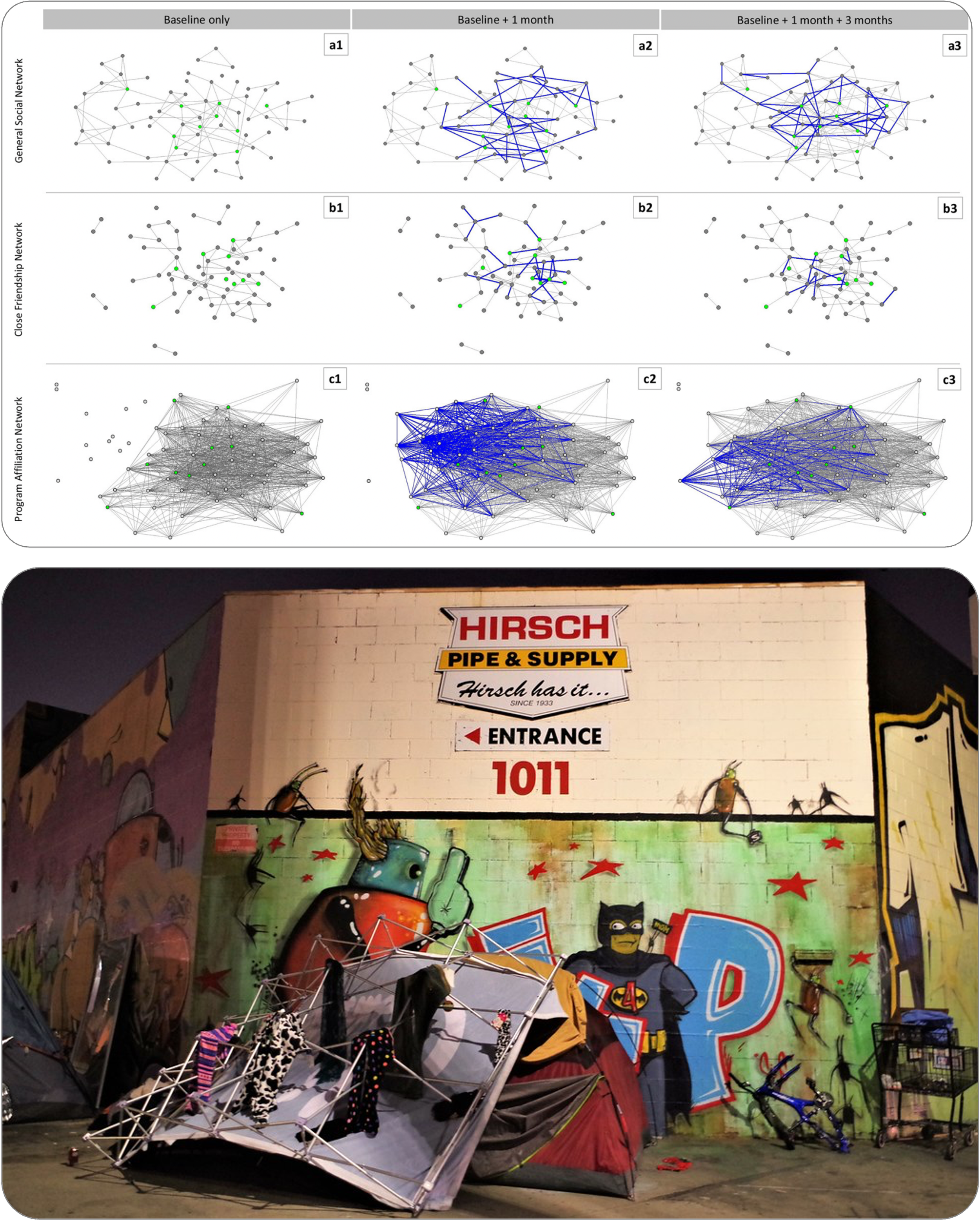
We used data from the 12-week peer-led HIV prevention intervention, "Have You Heard?" (HYH), deployed at a Los Angeles drop-in centre. We compared the predictive performance of three information diffusion models: (i) Independent Cascade Model (ICM), (ii) Linear Threshold Model (LTM), and (iii) Activation Jump Model (AJM).
We also mathematically manipulated the social networks in various ways:
Relaxed static assumption: We accounted for new ties that youth make over time.
Addressed multiplexity: We tested diffusion across three social contexts: (i) acquaintances, (ii) close friends, and (iii) common clubs or programmes.
Approach
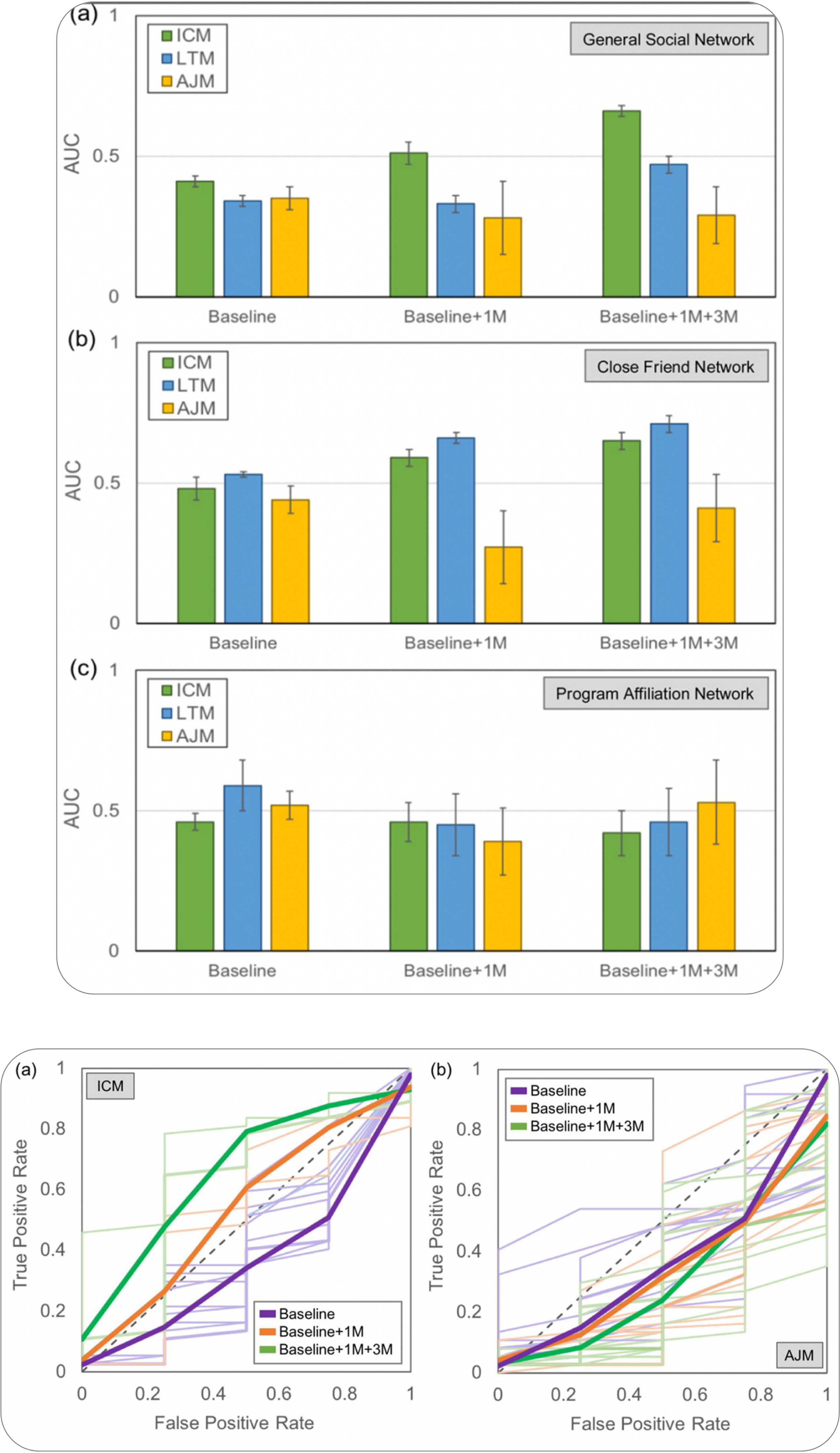
Temporal dynamics improve models: Adding new ties made by youth observed at different time points significantly improved the performance (as measured by “area under the curve”, or AUC) of the traditional ICM and LTM models, especially in the General Social and Close Friend networks.
Context is key: Program Affiliation ties (shared participation in clubs) were found not to be probable pathways of diffusion for ICM/LTM, as model performance declined when more of these ties were added. Conversely, Close Friend ties (with temporal additions) were confirmed as viable pathways of propagation.
Choosing where to augmentation data: Model performance was not significantly related to simple network density alone. Instead, the content of the temporal information (i.e. newly confirmed links) was what provided the predictive boost for ICM/LTM.
Capturing the “jumps” in social relations: The AJM model performed better than random only when external, non-participant ties were added to the baseline General Social Network. Its performance generally declined as newly formed in-study ties were added, suggesting its random jump mechanism is best suited for highly incomplete networks.
Key results
We advocated to the social services of LA County that:
Using program participation records (e.g. program affiliation data), which are collected routinely by drop-in centres, is a cheaper and more rapid proxy for social network data to inform peer leader selection in future interventions.
Explicitly modeling true network multiplexity (multiple relationship types simultaneously) using layered network diffusion models is important for capturing the complex nature of homeless communities.